
Polyamory Flag: Colours, Meaning and the Poly Symbols
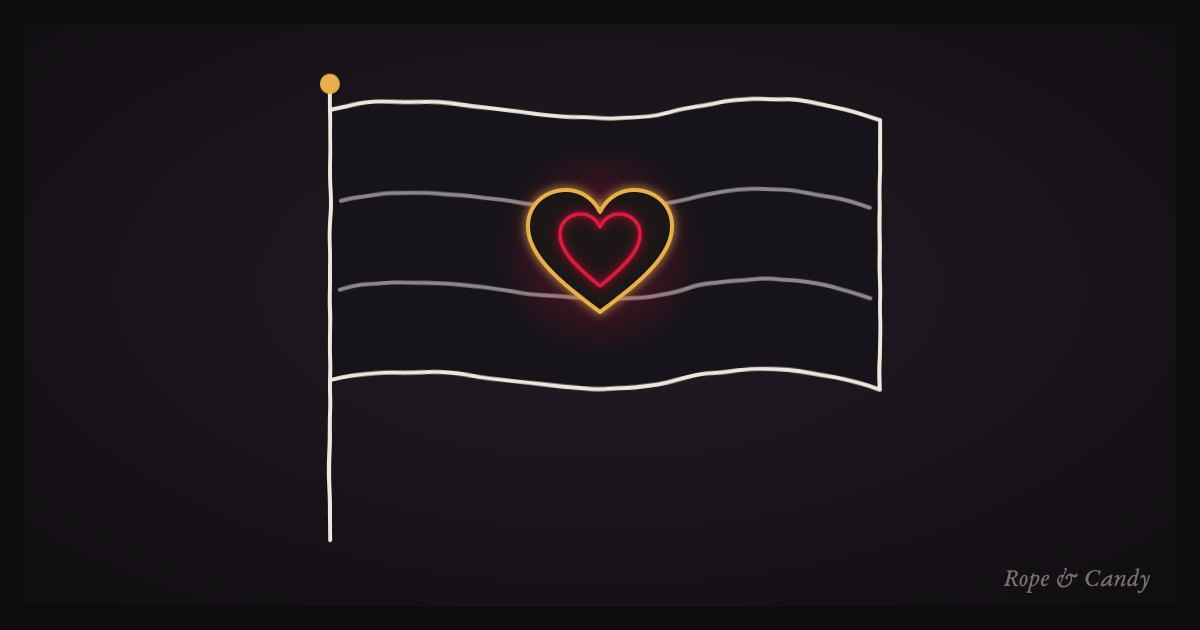
The polyamory flag comes in two versions. The original, designed by Jim Evans in 1995, has blue, red and black stripes with a gold pi symbol in the middle. A newer flag, chosen by a community vote in 2022, shows a gold heart-like shape on a white background with blue, red and purple. Alongside both sits the infinity heart, an older poly symbol that many people still wear. This guide explains each one, how people use them, and how to choose the polyamorous flag or symbol that feels right for you.
The original polyamory flag (1995)
This is the flag with the longest history. Jim Evans designed it in 1995: three horizontal stripes in blue, red and black, with a gold pi symbol at the centre.
It is simple, bold and easy to recognise once you know it. It is also the flag many long-time poly people feel attached to, because it was there when there was very little else. Some people who have been poly for decades still fly it, and you will see it on older websites, patches and stickers.
If you search for it, you will find many different explanations of what each stripe and the pi are meant to stand for. Treat those as people's readings rather than a single official answer. Plenty of poly folk simply love it because it has been around as long as they have.
The new polyamory flag (2022)
In 2022 a new design was chosen by a community vote. It has a gold heart-like shape on white, with blue, red and purple.
The vote mattered to many people. Rather than one person's design, the community picked a flag together, which feels fitting for a way of loving that is built on talking and agreeing. The new flag has a softer, lighter look than the original.
Like the older flag, it has gathered readings about what its colours and shape represent. You are free to take whichever meaning speaks to you, or none at all.
The infinity heart
The infinity heart is an older poly symbol: a heart woven together with an infinity loop. The idea it suggests is easy to feel even without an explanation, love that does not have to run out.
The infinity heart is often worn as jewellery. A small pendant, ring or tattoo is discreet enough that most people will not notice it, and recognisable enough that other poly people often will. For anyone who is not out at work or with family, that quiet recognition can be exactly the point.
Which polyamorous flag should I use?
There is no wrong answer. A few questions can help you decide.
Do you have history with the original? If you have been poly for years and the 1995 flag was part of that, keep flying it. Nobody gets to tell you it is out of date.
Do you like the idea of a community choice? The 2022 flag was picked by a vote, which some people find meaningful in itself.
Do you want to be discreet? The infinity heart can be worn every day without announcing anything to people who would not understand.
Do you want to show more than one part of yourself? Many people pair a poly flag with a bisexual, pansexual, rainbow or other flag. There is no rule against layering.
Some people fly both flags. Some use neither and simply live their relationships openly. A symbol is a way of saying something; it is never a test of how poly you are.
How people use poly symbols
At pride. Some people carry a poly flag at pride, alone or alongside other flags. If you march, check whether there is a poly or non-monogamy group locally.
On profiles. A small flag or infinity heart in a dating bio or social profile is a quick signal. Our guide to polyamorous dating apps covers how to write the rest of your profile.
At home. A flag on the wall, a mug, a pin on a jacket. For some people it is a quiet reminder of the life they have built.
As a gift. A pendant for a partner, or a matching pin for everyone in your polycule, can mark a relationship in a way that feels personal.
With care. Displaying a symbol can out you to people who know what it means. Think about who will see it, especially at work or around family, and about any partners or metamours who might be outed alongside you. If you are planning to tell people, our guide to coming out as polyamorous helps you plan the conversation.
A little flag etiquette
Symbols carry feelings, so a few kind habits help.
- Ask before you add a poly flag to a shared photo or a partner's things. Not everyone in a polycule is out in the same places.
- Do not argue about which flag is right. People who love the original and people who love the new one are on the same side.
- Let people explain their own meaning. If someone tells you what their flag or pendant means to them, take their word for it.
- Be careful with assumptions. Someone wearing an infinity heart may be poly, curious, or simply fond of the design.
Are polyamorous people LGBTQ?
People often ask this alongside questions about the flags. The short answer: polyamory is a relationship style, not a sexual orientation. A poly person can be straight, gay, bisexual, pansexual or anything else.
In practice, the overlap is large. Many poly people are also queer, and many LGBTQ communities are welcoming to non-monogamy. Whether polyamory itself belongs under the LGBTQ umbrella is still debated, and you will hear strong views on both sides. What most people agree on is that poly people deserve the same respect for their relationships as anyone else.
Behind the flag: what polyamory looks like in real life
A flag is shorthand for a lot of everyday life. If you are new and trying to work out whether the symbols are for you, our guides to what polyamory is and am I polyamorous? are good places to start.
People describe many benefits of polyamory: more people to love and be loved by, a wider support network, and a habit of honest communication that often spills into every relationship. It also takes time, care and a lot of talking. The flag celebrates the love; the work happens at the kitchen table.
You will also meet some community slang. A cowboy or cowgirl, for example, is a monogamous person who dates someone poly while hoping to pull them away from their other partners. If you are dating across that line, our page on mono-poly relationships covers how it can work honestly. For the rest of the vocabulary, see our polyamory terms glossary.
We notice these symbols more than you might think. At our dinners, a small infinity heart on a necklace has started more than one conversation between strangers, usually with the words "Oh, you too?" Whether you call yourselves poly, open, swingers or simply curious, it is good to be around people who recognise each other.
Take Maya, an illustrative example. She wore an infinity heart for a year before telling her sister she was poly. When she finally did, her sister pointed at the pendant and said she had looked it up months ago. The conversation was easier than Maya had feared.
A symbol is an invitation
Flags and symbols are a way of saying "this is who I am" and "you are welcome here". The best place to feel that is in person, among people who do not need anything explained. If you would like to meet open-minded couples and singles who already live this way, you can join Rope & Candy. It is free and takes one email, and when someone from our team is in your city, we meet you for a coffee or a dinner. Nothing is expected after.
Questions people ask
What does the polyamory flag look like?
There are two. The original, designed by Jim Evans in 1995, has blue, red and black stripes with a gold pi symbol. A newer design, chosen by a community vote in 2022, shows a gold heart-like shape on white with blue, red and purple.
What is the infinity heart?
The infinity heart is an older symbol of polyamory: a heart joined with an infinity loop. Many poly people use it on jewellery, pins and profiles, sometimes instead of a flag.
Are polyamorous people considered LGBTQ?
Polyamory is a way of doing relationships, not a sexual orientation, so it is not automatically part of LGBTQ identity. Many poly people are also queer, though, and plenty of LGBTQ spaces welcome them. Whether polyamory belongs under the umbrella is still debated.
What is cowboying in polyamory?
A cowboy, or cowgirl, is a monogamous person who dates someone poly while hoping to pull them away from their other partners into a one-on-one relationship. It is widely seen as disrespectful because it ignores the poly person's stated way of loving.